
AS6081 vs AS6171: Which Standard Actually Applies to Your Parts
Two standard numbers show up on nearly every independent distributor’s website, usually side by side and usually without explanation: AS6081 and AS6171. Buyers treat them as interchangeable badges. They are not interchangeable, they are not both badges, and the difference decides what you can actually ask a supplier to hand you.
The short version: AS6081 describes how a distributor runs its business. AS6171 describes what a laboratory does to your parts. One is a quality system you can be certified to. The other is a test methods standard you apply to a lot.
What AS6081 covers
AS6081 is the SAE standard for Fraudulent/Counterfeit Electronic Parts: Avoidance, Detection, Mitigation, and Disposition — Distributors. Its subject is the distributor’s process, not the part in front of you.
It sets requirements for how a distributor sources — supplier approval, traceability records, purchasing controls — how it plans inspection, how it quarantines and reports suspect parts rather than returning them to the market, and how it responds when something escapes. A distributor is certified to AS6081 by an accredited body. It is a claim about the company.
That makes it a genuinely useful filter when you are choosing who to buy from. It tells you nothing about the reel on your bench.
What AS6171 covers
AS6171 is a test methods standard: General Requirements, Suspect/Counterfeit, Electrical, Electronic, and Electromechanical Parts, published in 2016 by SAE’s G-19A test laboratory committee.
It has two parts. The general requirements document defines a risk-based methodology — you classify the part (active or passive, simple or complex, electromechanical), establish the risk level from the application and the sourcing history, and the standard tells you which tests and what sample size that risk level calls for. Then eleven slash sheets specify each method precisely, so that two accredited labs running the same method produce comparable results:
- /2 — external visual inspection, against the manufacturer’s own drawing
- /3 — X-ray fluorescence (XRF), lead-finish and package composition
- /4 — destructive physical analysis (DPA), including decapsulation
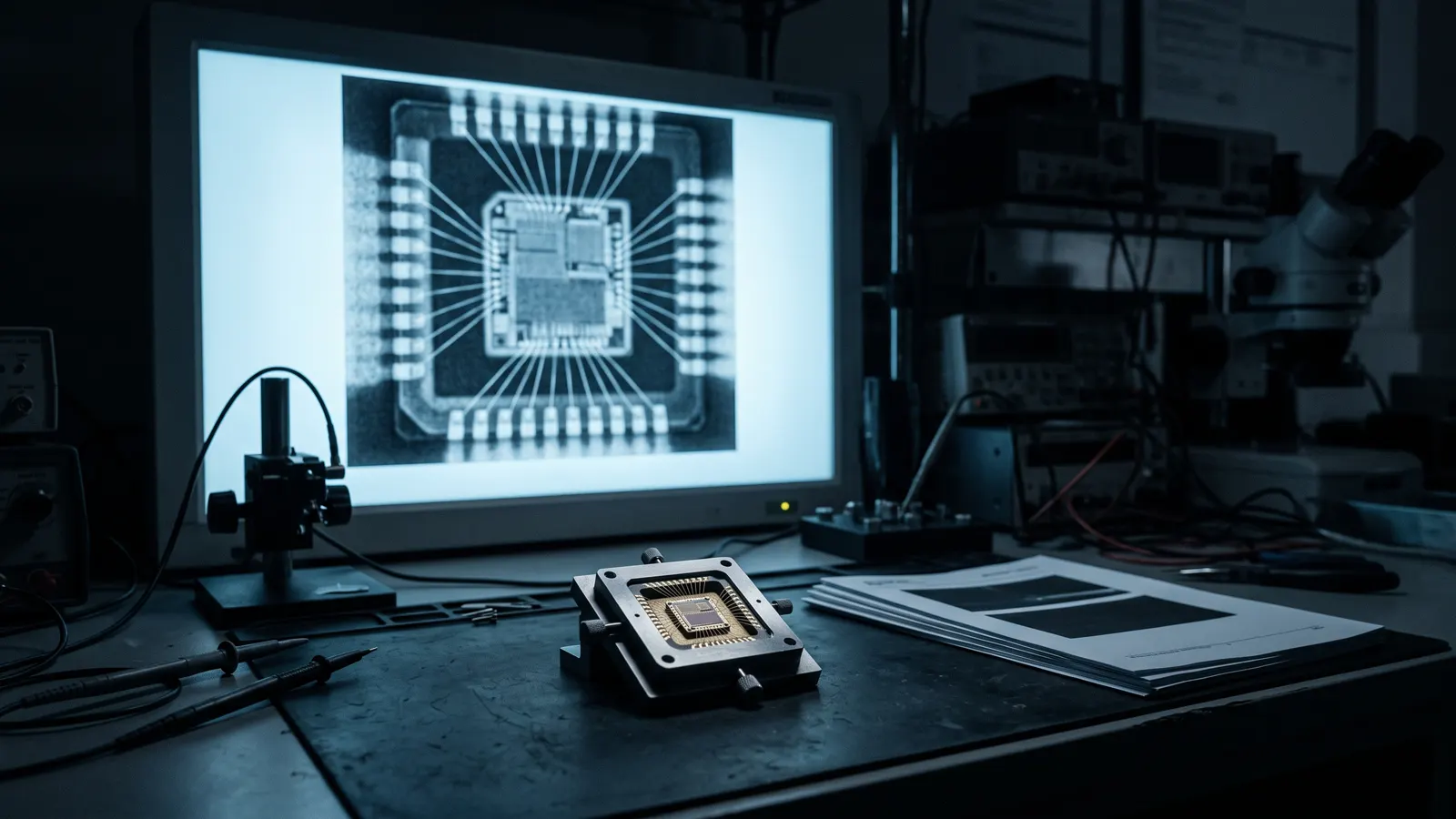
- /5 — radiological (X-ray), die and lead-frame geometry
- /6 — acoustic microscopy, delamination and internal voids
- /7 — electrical test, DC and AC parameters
- /8 and /9 — Raman and FTIR spectroscopy, materials and coatings
Laboratories are accredited to AS6171 by bodies such as ANAB. The output is a report on a specific lot.
What changed in AS6081 Rev A
This is the part most comparisons are out of date on. AS6081 Revision A, released in April 2023, dropped the test methods that were unique to AS6081 and now defers to AS6171 for test and inspection.
So the two standards stopped competing. AS6081 kept the ground it was always strongest on — the distributor’s quality system — and handed the laboratory work to the standard written by a laboratory committee. Where the earlier revision made comprehensive electrical testing optional, AS6171 requires electrical test at ambient as part of its risk-driven sequences, and specifies methods, like aggressive acetone resurfacing to expose remarking under a recoat, that the older document did not.
If you are reading a supplier page that presents AS6081 and AS6171 as rival choices, you are reading something written before 2023.
So which one should you ask for?
Both, for different questions.
Ask about AS6081 when you are qualifying a supplier. Are they certified, by whom, and is the certificate current? It belongs in the same conversation as ISO 9001, AS9120 and ERAI membership — see how to evaluate an electronic component supplier for the rest of that checklist.
Ask about AS6171 when you are buying a specific lot. The useful question is not “do you test?” but:
- Which AS6171 methods were run on this lot, and to which risk level?
- What was the sample size, and how was it chosen?
- Is the lab accredited to AS6171, and can I have the report before the parts ship?
“We are AS6081 certified” answers a question about the company. “This lot was screened to AS6171 at Risk Level 3, methods /2, /3, /5 and /7, report attached” answers a question about your parts. When something goes wrong on the line, only the second sentence is evidence.
When does the testing spend make sense?
Not on every line. The variables that should drive it are the ones AS6171’s own risk model uses: whether the part has full manufacturer traceability, how targeted it is by counterfeiters — high-value parts with no authorized supply are where the effort concentrates — where the board ends up, and what a field failure costs relative to the part price.
A supplier who applies the same test level to every line is either overcharging on the easy ones or under-testing the hard ones. The risk-based structure of AS6171 exists precisely so that decision can be defended rather than guessed.
For the individual checks and what each one actually catches, see spotting counterfeit electronic components.
How Makat handles it
Parts that reach us without full manufacturer traceability are tested before they ship, by accredited partner labs, to AS6081 and AS6171 as the risk warrants — with inspection sitting between the supplier and you rather than after the parts arrive at your line. You get the report.
We are ISO 9001:2015 certified and an ERAI member, we screen suppliers against ERAI fraud data and blacklists before they are used, and we carry $10M in product liability insurance. Because we buy and resell as principal, Makat is the Vendor of Record: one PO, one invoice, one company accountable for the result. More on how we handle quality.
Need this part sourced?
Send the line and our AI agents scan the whole network — verified offers, one company accountable for the result.