
Electronic Component Alternatives: How to Find a Substitute You Can Actually Use
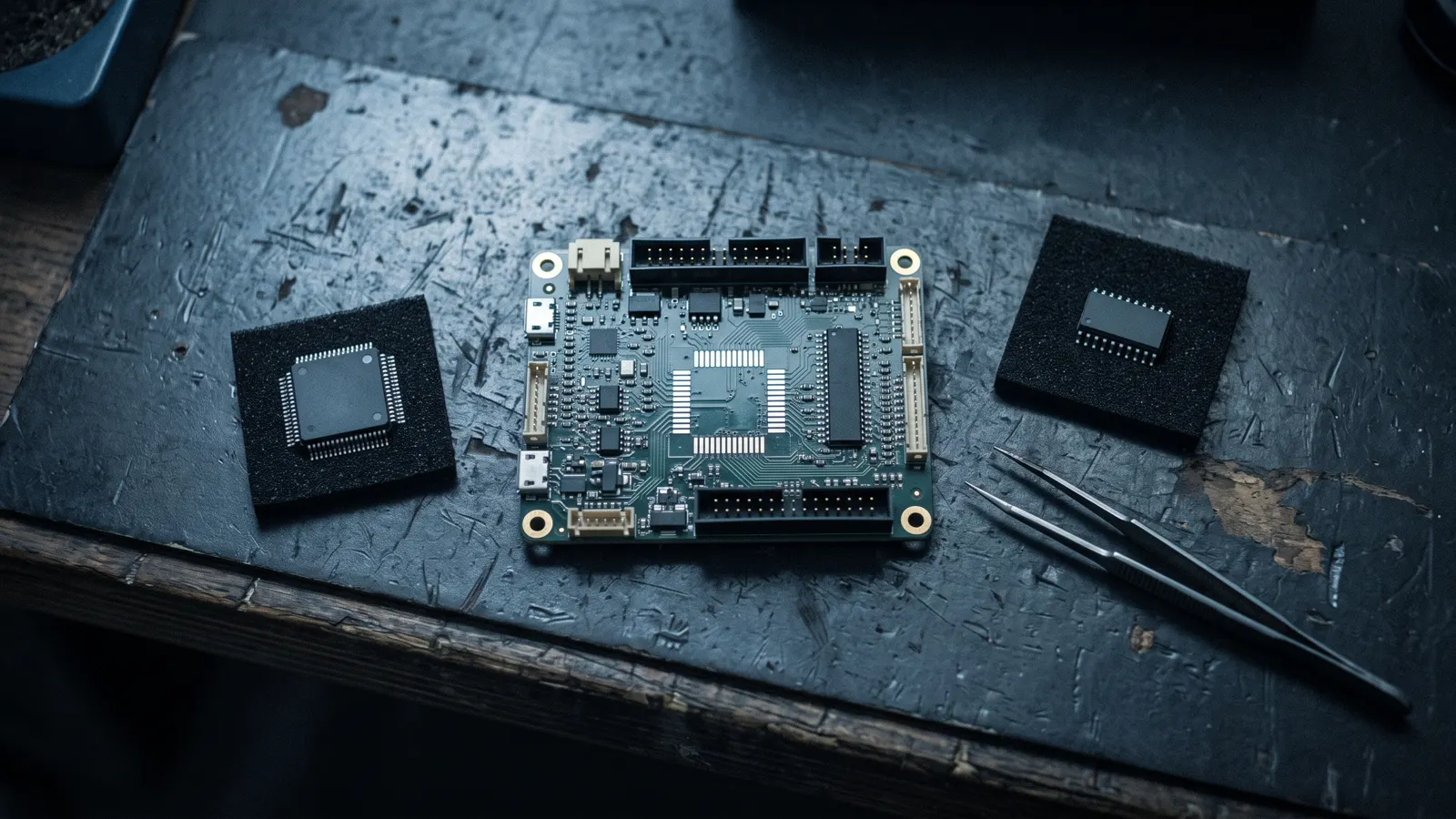
“Find an alternative” is the first suggestion whenever a part goes obsolete or into allocation, and it is usually offered as though it were the easy option. It is not the easy option. It is a different project with its own schedule, and whether it is faster than sourcing the original depends entirely on which grade of alternative you end up with.
Knowing which grade you are looking at, before the schedule is committed, is the whole exercise.
The four grades of alternative
They differ by how much verification work they impose, and the difference is weeks.
Same part, different package or grade. The identical die in a different package, or a wider temperature or tolerance grade of the same family. Function is unchanged. The work is mechanical — footprint, height, thermal path — and requalification is usually limited to a build and an environmental check.
Manufacturer-designated replacement. The manufacturer’s own successor part, named in the obsolescence notice. They have done the comparison and stand behind it. Verify the errata and any changed default states, then treat it as low risk. Always look for this first; it is frequently overlooked because nobody reads the PCN.
Competitor cross-reference. A different manufacturer’s functionally equivalent part, often pin-compatible. This is where most of the effort and almost all of the surprises live. Pin-compatible is a statement about the footprint, not about behaviour.
Redesign. A different part requiring circuit or firmware changes. Sometimes the correct answer for a long-lived product, never the fast one.
What a datasheet comparison will not tell you
Two parts can match on every headline parameter and behave differently in your circuit. The differences concentrate in a predictable set of places:
- Timing at the edges. Setup and hold, propagation delay, startup and power-up sequencing. Typical values match; the corners are where designs break.
- ESR and ripple behaviour on capacitors, which decides whether a regulator loop stays stable. A capacitance and voltage match tells you very little here.
- Thermal derating curves. Same rating on the front page, different behaviour at 85°C in your enclosure.
- Default and reset states on anything programmable. A different power-on default is a firmware change disguised as a component substitution.
- Errata. Not in the datasheet by definition. Read them; they are where the real differences between “equivalent” parts are documented.
- Process and handling. MSL rating, reflow profile, package coplanarity. A substitution that is electrically perfect can still cost you yield.
- Long-term availability. Substituting an obsolete part for one that is itself NRND buys eighteen months and a repeat of the same project.
Where to look for candidates
The manufacturer’s PCN or obsolescence notice first, for the designated replacement.
Manufacturer cross-reference tools, which are accurate about their own parts and optimistic about competitors’.
Distributor parametric search, filtered on the parameters that actually constrain your design rather than on the part’s headline category. This is the most productive route for passives and general-purpose analogue.
Your own BOM. Frequently the best alternative is a part you already approve and buy for another product. It is qualified, it has a supply history, and it consolidates volume rather than fragmenting it — the same move that drives BOM cost reduction.
Scope the qualification before you commit
The mistake that costs schedule is committing to an alternative on a datasheet comparison and discovering the qualification work afterwards. Answer these first:
- Does it change the footprint, the assembly process or the reflow profile?
- Does it require firmware changes?
- Does it touch anything under regulatory approval — safety, EMC, medical, auto?
- Does the customer contract require approval or requalification for a substitution? On many industrial and defence programmes it does, and that approval is measured in months.
- Is it available in production quantities, from more than one source, for the remaining life of the product?
If any of those is a yes, compare the alternative honestly against sourcing the original from the open market. On a part with existing channel stock, sourcing often wins on schedule even at a higher unit price — a qualification cycle routinely costs more in engineering hours and delay than the price delta on the parts.
Do both in parallel
The two paths are not exclusive, and running them together is almost always right on a constrained part. Sourcing gives you a possible answer in days; qualification gives you a durable answer in weeks and permanently reduces exposure on that line. Starting qualification only after sourcing fails wastes the weeks in which it could have been running for free.
How Makat handles it
Send the part number and we search both directions at once: the original across the open market — independent distributors, excess inventory, surplus from cancelled builds — and the alternatives that are actually purchasable in your quantity, rather than the ones that merely exist in a cross-reference table.
Offers typically come back in 3 to 48 hours, with no MOQ. Makat buys and resells as principal — Vendor of Record on one PO and one invoice, ISO 9001:2015 certified, ERAI member, $10M product liability insurance — and anything without full manufacturer traceability is tested to AS6081 and AS6171 by accredited labs before it ships. Search a part or send us a list.
Need this part sourced?
Send the line and our AI agents scan the whole network — verified offers, one company accountable for the result.